
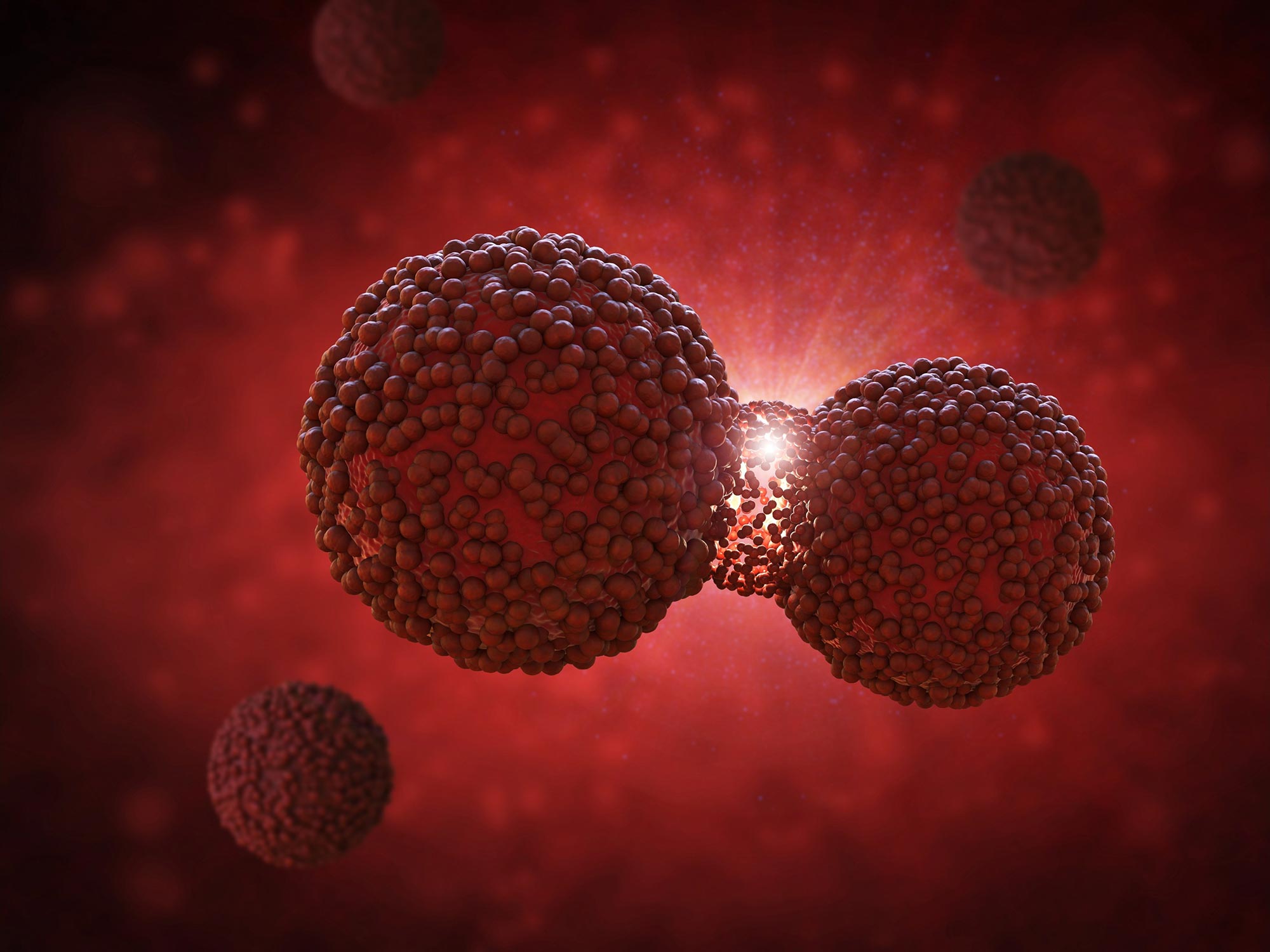
The double ring, spool-like structure of RAD52 protects replicating DNA in dividing cells.
A study led by the University of Iowa has uncovered the surprising structure of the DNA repair protein RAD52 as it binds to and stabilizes replicating DNA in dividing cells. This new insight into the structure and function of the RAD52-DNA complex could aid in the development of novel anti-cancer drugs
“RAD52 is a coveted drug target for treating cancers that have DNA repair deficiencies, including breast and ovarian cancers, and some glioblastomas,” explains Maria Spies, PhD, professor of biochemistry and molecular biology in the UI Carver College of Medicine, and senior author of the new study that was published April 2 in Nature. “This protein is an attractive target for new anti-cancer drugs because while it is dispensable in healthy human cells, RAD52 becomes essential for survival of cancer cells, which are deficient in DNA repair function, such as those with defects in BRCA1 and BRCA2 genes.”
Cancers with DNA repair deficiencies rely on alternative proteins to compensate for damaged repair pathways, enabling rapid growth and survival despite persistent DNA damage. RAD52 is one such backup protein. As a result, molecules that inhibit RAD52 function may offer an effective strategy for treating these cancers.
It has already been shown that RAD52 inhibitors can selectively kill cancerous cells and minimize the toxicity associated with radiation and chemotherapy. This ability is similar to the action of the first drugs approved to target BRCA1/2 deficient cancers, the so-called PARP (poly-ADP-ribose polymerase) inhibitors, which are now in clinical use. While almost 15% of patients treated with the PARP inhibitor olaparib remain disease free for more than five years, many develop resistance within the first year.
“Targeting RAD52 (independent of or together with PARP inhibition) will increase the repertoire of available therapies,” Spies says. “However, to develop drugs that will inhibit RAD52 in cancer cells, we first need to understand how RAD52 functions at the molecular, structural, and cellular level.”
A new shape reveals possible targets for drug therapy
The fact that RAD52 appears to be dispensable in normal human cells but essential for the survival of cancer cells experiencing defective DNA repair creates both an advantage and a challenge. The advantage is that inhibiting RAD52 should kill cancer cells with minimal negative effects on the patient’s healthy cells. The challenge is figuring out what functions and features of RAD52 should be targeted.
In the new study Spies and her UI team, collaborating with Pietro Pichierri, PhD, professor of molecular medicine, at the Istituto Superiore di Sanità, in Rome, Italy, and M. Ashley Spies, PhD, professor of drug discovery and experimental therapeutics in the UI College of Pharmacy, have discovered structural and functional information about RAD52 that may help them develop new, specific ways to inhibit this protein.
Double ring structure protects DNA
Spies and Pichierri had previously discovered that RAD52 is important in protecting stalled DNA replication forks. Their work suggested that this new function of RAD52 facilitates the survival of cancer cells.
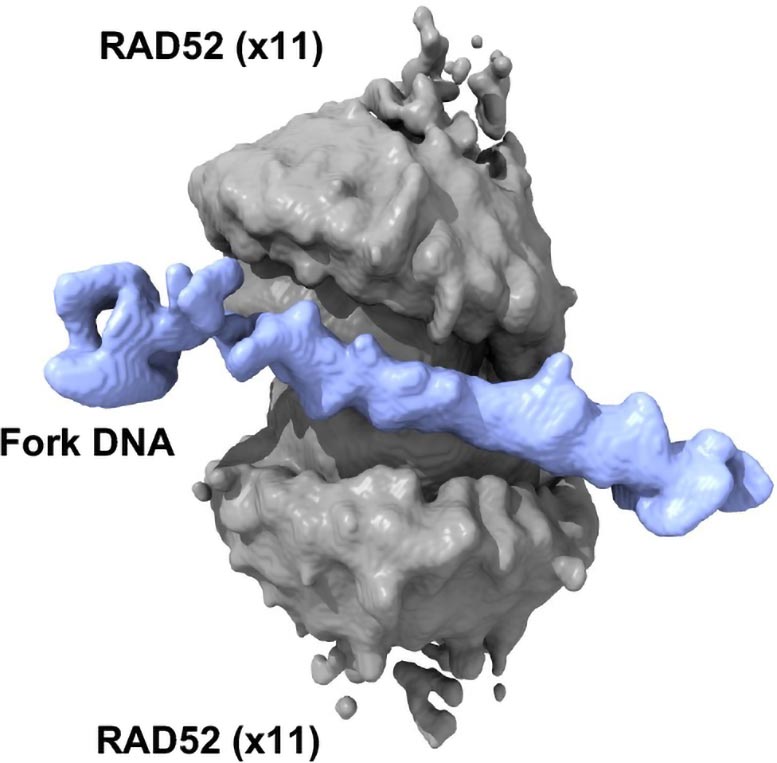
In the new study, Spies’ team used cryogenic electron microscopy (CryoEM) to show that RAD52 proteins form an unexpected spool-like structure composed of two rings of RAD52, each containing 11 copies of protein, that engages all three arms of the “DNA replication fork,” rearranges the fork structure, and protects it from excessive degradation.
To obtain this image, the team created a DNA substrate, which resembles a stalled DNA replication fork. The substrate fixes the RAD52 complex in place by bringing the two rings together with all three DNA arms. Both single and double-stranded DNA features interact with RAD52 and hold the structure in place, allowing the team to obtain a detailed 3D structure of the whole protein-DNA complex.
Using specialized microscopes built in Spies’ lab, the researchers were also able to monitor the RAD52-DNA transactions at the single-molecule level, revealing that the fork protection occurs through dynamic protein-DNA interactions.
“Although the single ring structure had been observed previously, this is the first structure showing the two rings together on the DNA, doing something unexpected,” Spies says. “This new structure provides clues about which important areas of the protein can be targeted for future drug discovery.”
Targeting RAD52 to create new cancer drugs
Spies’ team already has small molecules that bind and inhibit RAD52, but to develop these molecules into testable drugs, they need to be further refined and modified to make them more effective and more specific.
The results of Spies lab’s structural and biophysical work were complemented by computational studies by M. Ashley Spies, and cell-based and super-resolution imaging by the Pichierri group in Rome. In combination, the labs’ efforts revealed the importance of the two-ring RAD52 architecture to its ability to act as a DNA replication gatekeeper and to the survival of cancer cells.
“This work and our structure-activity knowledge gained in this study sets up future work on understanding the RAD52 activities and regulation and offers new targets for its inhibition,” Spies says. “Hopefully, this information will help us develop new inhibitors of this protein and tap the potential of RAD52 as an anti-cancer drug target.”
Reference: “The RAD52 double-ring remodels replication forks restricting fork reversal” by Masayoshi Honda, Mortezaali Razzaghi, Paras Gaur, Eva Malacaria, Giorgia Marozzi, Ludovica Di Biagi, Francesca Antonella Aiello, Emeleeta A. Paintsil, Andrew J. Stanfield, Bailey J. Deppe, Lokesh Gakhar, Nicholas J. Schnicker, M. Ashley Spies, Pietro Pichierri and Maria Spies, 2 April 2025, Nature.
DOI: 10.1038/s41586-025-08753-1
In addition to Maria Spies, Pichierri, and Ashley Spies, the study team also included co-lead authors Masayoshi Honda, PhD, Mortezaali (Ali) Razzaghi, PhD, both research scientists in the Spies UI lab. In addition, Spies credits the expertise of Nick Schnicker, PhD, and Lokesh Gakhar, PhD, the current and former directors of the UI Protein and Crystallography Core for their assistance in starting the structural studies of RAD52.
The study was funded in part by grants from the National Cancer Institute, part of the NIH.
Never miss a breakthrough: Join the SciTechDaily newsletter.
Follow us on Google and Google News.